Learning Outcomes
i. Define momentum and explain its significance in physics.
ii. Understand the concept of conservation of momentum and its application to closed systems.
iii. Differentiate between elastic and inelastic collisions based on the transfer of kinetic energy.
iv. Apply the principle of conservation of momentum to analyze collisions and predict the outcomes.
v. Appreciate the relevance of momentum conservation in various physical phenomena.
Introduction
As we observe the world around us, we are constantly bombarded with interactions between objects. From the gentle jostle of two billiard balls to the tumultuous impact of two cars colliding, these interactions are often characterized by a transfer of momentum, the property of an object that describes its mass and velocity. This lesson delves into the fascinating concept of conservation of momentum, exploring how this fundamental principle governs the motion of objects in collisions.
i. Momentum: The Measure of Motion's Persistence
Momentum is defined as the product of an object's mass and its velocity. It is a vector quantity, meaning it has both magnitude and direction. The SI unit of momentum is the kilogram-meter per second (kg·m/s). Momentum represents the resistance of an object to changes in its motion. The more massive an object is or the faster it is moving, the greater its momentum.
ii. Conservation of Momentum: A Fundamental Principle
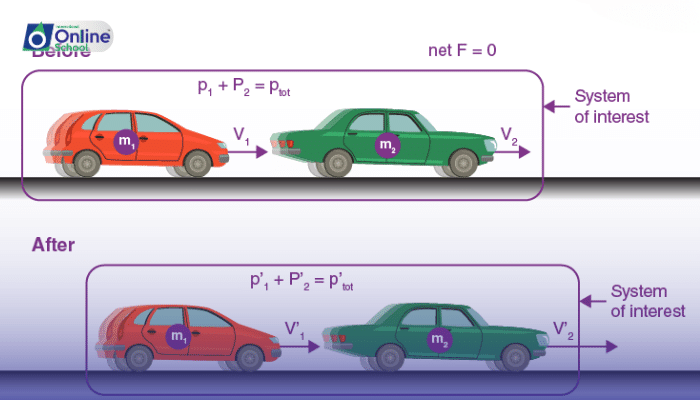
The principle of conservation of momentum states that the total momentum of a closed system remains constant, unless an external force acts on the system. This means that in a collision between two or more objects, the total momentum before the collision is equal to the total momentum after the collision.
iii. Types of Collisions: Elastic and Inelastic
Collisions can be classified into two main categories based on the transfer of kinetic energy: elastic and inelastic.
Elastic Collisions: In an elastic collision, there is no loss of kinetic energy. The colliding objects retain their total kinetic energy after the collision. Examples of elastic collisions include billiard ball collisions and bouncing balls.
Inelastic Collisions: In an inelastic collision, there is a loss of kinetic energy. Some of the kinetic energy is converted into other forms, such as heat or sound. Examples of inelastic collisions include car collisions and putty balls sticking together.
iii. Applications of Momentum Conservation
The principle of conservation of momentum has wide-ranging applications in various fields, including physics, engineering, and sports.
Physics: Momentum conservation is used to analyze collisions, predict the outcomes of rocket launches, and study the behavior of subatomic particles.
Engineering: Momentum conservation is applied in designing airbags, safety belts, and other impact-absorbing devices.
Sports: Momentum conservation plays a crucial role in various sports, such as baseball, where a player uses their momentum to swing a bat and hit a ball with considerable force.
Examples of Momentum Conservation in Action
Billiard Balls: When two billiard balls collide, their total momentum before the collision is equal to their total momentum after the collision, regardless of how they scatter.
Rocket Launch: The conservation of momentum principle is applied to calculate the velocity of a rocket after it ejects fuel, ensuring the rocket gains the desired momentum for its trajectory.
The principle of conservation of momentum stands as a cornerstone of physics, providing a fundamental understanding of how momentum is transferred and conserved in collisions. Its applications span a wide range of disciplines, from the intricate dynamics of subatomic particles to the design of safety devices and the analysis of sports techniques. By comprehending the concept of momentum conservation, we gain insights into the underlying mechanisms governing the motion of objects in our physical world.
